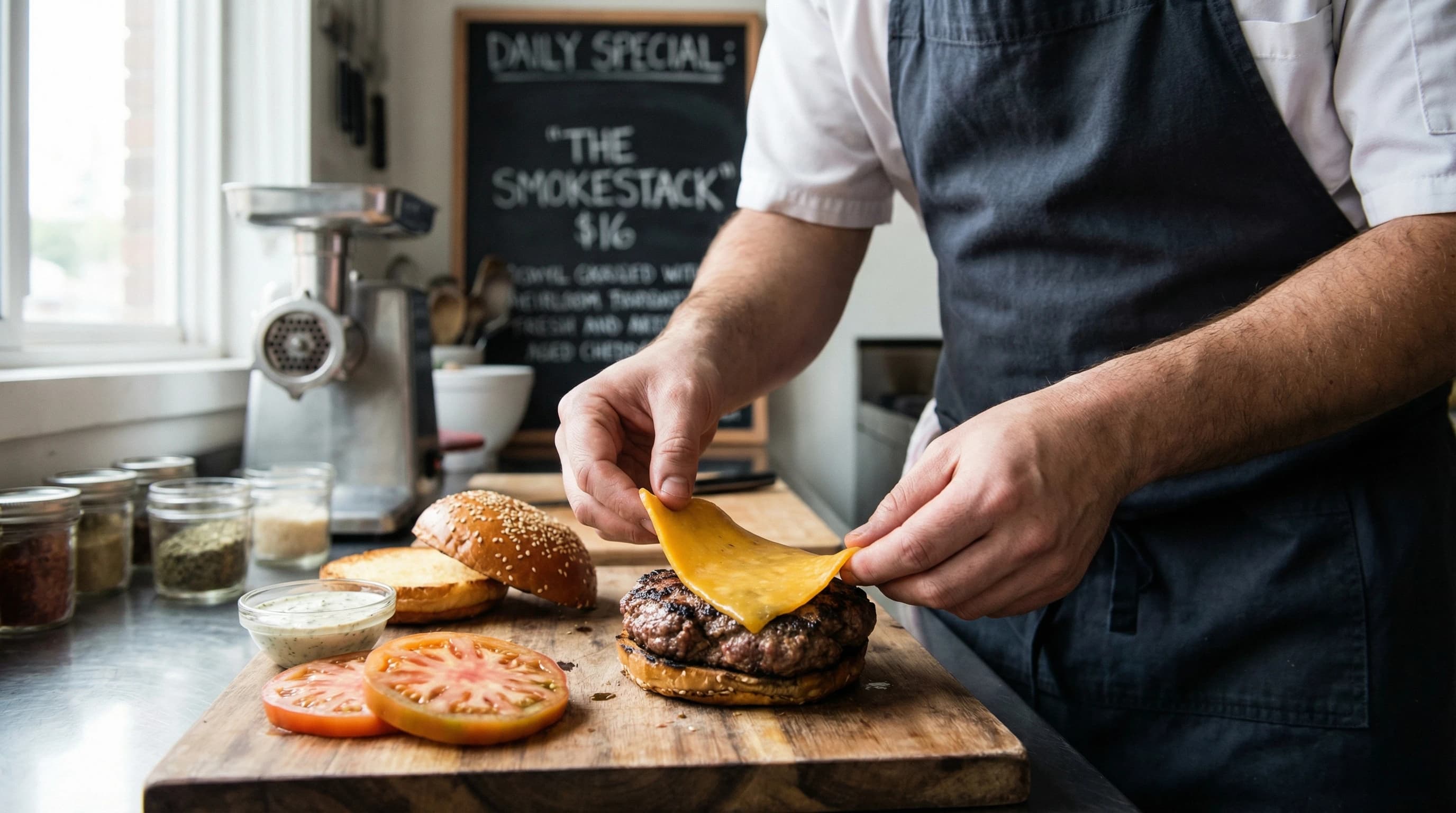
Walk into most chain burger restaurants and you know exactly what you're getting. The menu hasn't changed in years, the ingredients arrive pre-portioned in trucks, and every location from Seattle to Miami serves the same standardized product. It's predictable, it's efficient, and for decades, it dominated the American burger landscape.
But something's shifting. Across the country, a different kind of burger restaurant is thriving—one where chefs grind their own beef blends daily, source vegetables from farms within fifty miles, and change their menu based on what's actually in season. These aren't massive chains with thousands of locations. They're independent operators, often running just one or two restaurants, who've decided that burgers deserve the same thoughtful approach as any other culinary craft.
This is the craft burger movement, and it's redefining what America expects from its most iconic food.
The Gourmet-Casual Fusion Rewriting the Rules
For years, burgers occupied two distinct categories: fast food chains where you ate cheap and quick, or upscale restaurants where a burger might cost $25 and came with white tablecloths. The craft burger movement lives comfortably in neither space—and thrives because of it.
These restaurants have mastered what industry analysts call the "gourmet-casual fusion"—elevated ingredients and techniques delivered in approachable, affordable settings. You might pay $15-18 for a burger, but you're getting dry-aged beef from a specific farm, house-made pickles fermented for two weeks, and a sauce the chef developed over months of testing. The atmosphere stays relaxed, the service remains friendly, and you can still wear jeans and sneakers. It's the best of both worlds: serious food without the pretense.
This approach resonates powerfully with today's diners, who've become increasingly sophisticated about food quality while simultaneously rejecting stuffy dining experiences. They want to know where their beef comes from, but they don't want to dress up for dinner. They appreciate culinary skill, but they don't need a sommelier. Craft burger restaurants deliver exactly this combination, and the results speak for themselves—many independent burger joints now command lines around the block while nearby chains sit half-empty.
Small-Batch Philosophy, Big Flavor Results
The craft burger philosophy starts with a fundamental rejection of industrial food production. While chains optimize for consistency across thousands of locations, craft burger restaurants optimize for flavor at a single location. This shift in priorities creates entirely different approaches to every component.
Take beef sourcing. Chain restaurants typically contract with massive meat suppliers who process cattle from multiple farms and regions, grinding enormous batches to meet standardized specifications. The beef arrives frozen, pre-portioned into identical patties, ready to cook from a freezer to a flat-top. It's efficient. It's consistent. It's also limited by the lowest common denominator—meat from the slowest-growing cattle in the largest batches will always taste less interesting than carefully selected, smaller-lot beef.
Craft burger restaurants, by contrast, might work directly with a single ranch, buying whole animals and controlling the entire process. They select specific cuts—maybe chuck for richness, short rib for depth, brisket for texture—and grind custom blends in-house. The fat content gets adjusted based on the cooking method. The grind coarseness varies depending on whether they're making smash burgers or thicker patties. Some restaurants age their beef for 30, 40, or even 50 days before grinding, developing concentrated flavors that factory meat simply cannot achieve.
This same small-batch approach extends to everything else. Buns might come from a local bakery that makes just 200 per day, or the restaurant bakes them in-house each morning. Pickles and condiments get fermented or prepared on-site rather than arriving in industrial-sized jars. Even simple components like lettuce and tomatoes receive attention—restaurants source from nearby farms, selecting specific varieties for flavor and texture rather than just durability during shipping.
The result? Burgers that taste fundamentally different from what chains can produce, even when chains use nominally "premium" ingredients. It's the difference between industrial beer and craft beer, between mass-market coffee and single-origin beans. Small batches allow for quality and creativity that scale simply cannot match.
Chef-Driven Creativity Pushing Boundaries
Perhaps the most exciting aspect of the craft burger movement is watching actual chefs—people trained in culinary technique and flavor composition—turn their attention to burgers with genuine seriousness. These aren't just cooks following corporate recipes. They're professionals with the skills and freedom to experiment, innovate, and create.
Sauces have become a particular focus of chef-driven innovation. While chains stick to the usual suspects (ketchup, mustard, mayo), craft burger restaurants are developing signature sauces that function as genuine flavor engines. Miso-butter spreads add umami depth. Fermented hot sauces bring complex heat that builds slowly. Truffle aioli delivers earthy richness. These aren't random ingredients thrown together for novelty—they're carefully balanced compositions that complement specific beef blends and cooking methods.
Regional influences increasingly shape craft burger menus, with chefs incorporating local culinary traditions in creative ways. A New Mexico burger joint might top patties with roasted Hatch green chiles and locally made queso. Southern restaurants lean into fried green tomatoes, pimento cheese, and comeback sauce. Pacific Northwest spots feature wild mushrooms foraged from nearby forests. These regional touches create burgers that couldn't exist anywhere else, burgers that tell a story about their specific place and community.
The customization trend has also evolved beyond simple build-your-own options. Smart craft burger restaurants offer thoughtfully curated combinations—specific cheese and topping pairings designed to work together, seasonal specials that showcase ingredients at their peak, chef's choice options that let culinary professionals demonstrate their skills. It's customization with guidance, giving diners agency without overwhelming them with infinite mediocre choices.
Local Sourcing as Strategy, Not Just Marketing
Many restaurants claim to use "local ingredients" as a marketing buzzword. Craft burger restaurants actually do it, and not just for PR—local sourcing creates genuine competitive advantages.
Working directly with nearby farms means restaurants can source ingredients at peak freshness and quality. Tomatoes get picked ripe and arrive within 24 hours instead of spending a week in refrigerated trucks. Lettuce comes in crisp and flavorful rather than wilted and bland. These quality differences aren't subtle—diners notice when vegetables actually taste like something.
Local relationships also enable menu flexibility. When a farmer shows up with an unexpected harvest of heirloom tomatoes or fresh herbs, a craft burger restaurant can pivot immediately, creating a special that showcases whatever's exceptional that week. Chains can't do this. Their supply chains require planning months in advance, locking them into specific ingredients regardless of quality or seasonality.
The economic impact matters too. Money spent at craft burger restaurants tends to circulate within local communities—they're buying from regional farms, local bakeries, nearby suppliers. This creates a network of small food businesses supporting each other, strengthening local food systems in ways that corporate chains simply cannot replicate.
Sustainability naturally emerges from this local focus. Shorter supply chains mean lower transportation emissions. Restaurants can choose grass-fed beef from regeneratively managed pastures rather than feedlot cattle shipped from distant states. Many craft burger spots have moved to compostable packaging, reduced food waste through careful portion control, and found creative uses for trim and scraps. It's not perfect, but it's measurably better than the industrial food system that supports most chains.
The Bistro Burger Comeback
While smash burgers have dominated recent years, craft restaurants are leading a parallel revival of the bistro burger—thicker patties, taller builds, premium toppings stacked with architectural ambition. These burgers embrace indulgence without apology, treating the hamburger format as a canvas for genuine culinary expression.
Bistro burgers typically feature patties between 170-225g (6-8 oz), cooked to medium or medium-rare with pink centers and crusty exteriors. They might be topped with caramelized onions cooked in vermouth for hours, imported aged cheeses that cost $40 per kilogram, wild mushrooms sautéed in brown butter. Some get finished with foie gras, truffle shavings, or house-cured bacon that took two weeks to prepare.
This isn't excess for its own sake—it's a demonstration that burgers can hold their own against any other "serious" dish. These are burgers that rival steaks in quality and price, burgers that command the same respect as any other protein on a restaurant's menu. The craft burger movement has helped legitimize the idea that a $22 burger can represent genuine value when it showcases exceptional ingredients and skilled technique.
Quality Over Scale: Why It Matters
The fundamental tension between craft burger restaurants and chains comes down to competing visions of success. Chains measure success through scale—more locations, higher revenue, greater market share. Every decision gets filtered through the question: "Can we do this at 5,000 locations?"
Craft burger restaurants measure success differently. They're optimizing for quality, reputation, and sustainability at one or two locations. They ask: "Is this the best burger we can possibly make?" This different question leads to different answers, different priorities, and ultimately, different burgers.
Consumers increasingly reward this quality-first approach. Data from restaurant industry analysts shows growing consumer concern about ingredient sources, production methods, and corporate practices. Diners want transparency. They want to know that their food comes from identifiable sources, prepared by people they can actually see in an open kitchen. They're willing to pay more for this, and they're willing to wait in line for it.
The craft burger movement isn't trying to replace chains—McDonald's and Five Guys will always have their place. But it's proving that another model can thrive, one that prioritizes craftsmanship over convenience, quality over quantity, and flavor over standardization. These restaurants demonstrate that burgers can be both accessible comfort food and vehicles for genuine culinary ambition.
The Future of Craft Burgers
As we move deeper into 2025, the craft burger movement shows no signs of slowing. More chefs are taking burgers seriously as a culinary medium. More diners are seeking out independent restaurants that prioritize quality. And more cities are developing burger scenes where craft establishments compete not on price or convenience, but on flavor, creativity, and connection to their communities.
The movement has already influenced chains—even major corporations now advertise "never frozen" beef, house-made sauces, and premium ingredients in response to craft burger competition. But there's a limit to how far industrialized food production can adapt. Truly small-batch, chef-driven, locally sourced food requires a different business model entirely.
That's ultimately what makes the craft burger movement so important. It's not just about better burgers—though the burgers are definitely better. It's about preserving space in the food system for restaurants that prioritize quality over scale, for chefs who treat burgers with the same seriousness as any other dish, and for communities that value local food systems over corporate efficiency.
The next time you're choosing where to eat a burger, consider seeking out the independent spot with the line out the door, the restaurant grinding its own beef and fermenting its own pickles, the chef-driven place where the menu changes with the seasons. You'll pay a bit more. You might wait a bit longer. But you'll taste the difference between a burger made to maximize profit margins and a burger made to be actually, genuinely great.
That difference? That's the craft burger movement in action.
Frequently Asked Questions
What makes a burger "craft" versus regular fast food?
Craft burgers prioritize quality ingredients, small-batch preparation, and chef-driven creativity over standardization and scale. This typically means fresh-ground custom beef blends, locally sourced produce, house-made sauces, and preparation techniques that emphasize flavor rather than speed or consistency across thousands of locations.
Are craft burgers healthier than chain burgers?
Not necessarily—craft burgers are often higher in calories due to premium ingredients and larger portions. However, they frequently use higher-quality beef (grass-fed, hormone-free), fresh vegetables, and ingredients without preservatives or additives. The health benefits come from ingredient quality and transparency rather than lower calories.
Why do craft burgers cost more than chain burgers?
Craft burgers reflect higher ingredient costs (premium beef, local produce, artisanal buns), smaller economies of scale, labor-intensive preparation (fresh grinding, house-made components), and sustainable sourcing. You're paying for quality, craftsmanship, and ingredients that simply cost more to produce at small scale.
Can craft burger restaurants compete with major chains?
They're not trying to compete on the same terms. Chains win on convenience, speed, and price consistency. Craft burger restaurants compete on quality, creativity, and local connection. Both models can succeed—they serve different customer needs and occasions.
How can I find craft burger restaurants in my area?
Look for independent restaurants (not chains) advertising fresh-ground beef, local ingredients, or chef-driven menus. Check food blogs and local publications for "best burger" lists, which often feature craft establishments. Social media and Google reviews highlighting unique flavors and quality ingredients are good indicators of craft burger spots.